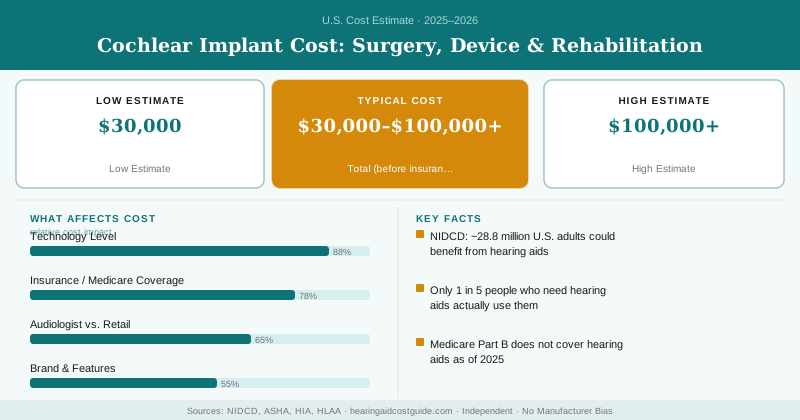
The NIDCD reports approximately 90,000 cochlear implant surgeries are performed in the United States each year — a number that’s grown steadily as candidacy criteria have expanded beyond the profoundly deaf. That stat matters for one reason: if your hearing loss is severe enough and hearing aids aren’t helping, cochlear implants aren’t a last resort anymore. They’re a covered, well-established option.
The total cost before insurance runs $30,000 to $100,000. That number is real. So is this one: most insured adults pay $3,000–$9,000 out-of-pocket. Medicare covers cochlear implants. Most private insurers do too. This article breaks down what you’re actually paying for — and what you can expect from each step.
2026 estimates based on national averages. OTC devices available direct; prescription aids require audiologist fitting. Actual costs depend on provider and plan details.
What Drives the $30,000–$100,000 Total
The implant itself, the surgery to place it, the post-operative programming, and the rehabilitation therapy all have separate price tags. None of them are cheap on their own.
| Cost Component | Estimated Cost |
|---|---|
| Internal implant device | $25,000–$50,000 |
| Surgery (implantation) | $15,000–$30,000 |
| Hospital/facility fee | $10,000–$25,000 |
| Anesthesia | $2,000–$5,000 |
| Audiological mapping/programming (per session) | $150–$300 |
| Programming sessions (Year 1, typically 6–10) | $900–$3,000 |
| Auditory rehabilitation/AVT therapy | $3,000–$10,000 |
| Total (before insurance) | $30,000–$100,000+ |
The device cost varies by manufacturer but not dramatically from your perspective as a patient. Cochlear Corporation, MED-EL, and Advanced Bionics are the three FDA-approved manufacturers in the US. All three produce high-quality implants. The choice between them is typically made by your cochlear implant team based on your anatomy, your hearing profile, and the surgeon’s experience — not consumer pricing.
The Implant Device Itself
The internal component — a receiver/stimulator that’s surgically placed under the skin behind your ear, plus an electrode array threaded into the cochlea — costs $25,000–$50,000. You don’t purchase this directly. It’s billed through the hospital or surgical center as part of the procedure.
The external sound processor (the part you wear) is typically included in that price when your insurance covers the system. Replacement processors, if needed later outside warranty, run $5,000–$10,000.
Surgery Costs
Cochlear implant surgery is performed under general anesthesia. It takes 2–4 hours. The surgical fee itself runs $15,000–$30,000 — that’s the surgeon’s charge. Add the hospital or outpatient surgical center facility fee ($10,000–$25,000) and anesthesia ($2,000–$5,000), and you’re looking at $27,000–$60,000 just for the operative portion.
That’s why insurance coverage is so central to this decision. Without it, the surgery alone exceeds what most people can pay.
Audiological Mapping: The Overlooked Cost
After surgery comes activation — the day your implant is first turned on. That’s followed by a series of mapping sessions where your audiologist fine-tunes the electrical stimulation to match your auditory nerve’s response. Each session runs $150–$300.
In the first year, you’ll typically have 6–10 mapping appointments. That’s $900–$3,000. Frequency decreases after the first year, but you’ll continue to need occasional adjustments for the life of the device — especially after processor upgrades.
Mapping refers to programming each electrode channel in the implant to find the softest sound you can detect (threshold) and the loudest comfortable level. Your brain needs time to learn the new electrical signals. Each session refines the map as your auditory cortex adapts — which is why the first year’s intensive schedule matters so much for long-term outcomes.
Auditory Rehabilitation
Getting the implant is step one. Learning to use it is step two — and it takes work. Auditory-verbal therapy (AVT) and general auditory rehabilitation help your brain interpret the new signals. Sessions with an audiologist or speech-language pathologist trained in cochlear implant rehabilitation run $100–$200 per hour. A full program in the first year costs $3,000–$10,000.
This step is frequently underbudgeted by patients who focus only on the device and surgery costs. Don’t skip it. Research consistently shows that post-implant rehabilitation is one of the strongest predictors of speech understanding outcomes.
Who Qualifies: Candidacy Criteria
Insurance coverage depends on meeting specific audiological criteria. The FDA and CMS (Centers for Medicare & Medicaid Services) define adult candidacy as:
- Bilateral severe-to-profound sensorineural hearing loss (thresholds of 70 dB HL or worse)
- Word recognition score below 50% in the best-aided condition (meaning even with the best hearing aids you can fit, you still can’t understand more than half of spoken words in a sentence test)
- Limited benefit from appropriately fitted hearing aids
These criteria have been expanding. Some cochlear implant centers now evaluate patients who score up to 60% on word recognition in more demanding listening conditions. If you’re on the borderline, an evaluation is worth pursuing.
Don’t assume you don’t qualify because hearing aids help somewhat. If you’re struggling significantly in noise, missing important conversations, or relying heavily on lip-reading even with hearing aids, ask your audiologist for a formal cochlear implant candidacy evaluation. You may be surprised where you land.
Medicare Coverage
Medicare Part B covers cochlear implants when you meet medical necessity criteria. Here’s what that means practically:
- Part B pays 80% of the Medicare-approved amount after your deductible ($240/year in 2024)
- You’re responsible for the remaining 20% — unless you have a Medigap supplement
- With Medigap, your out-of-pocket may drop to near zero
- Medicare covers the implant, surgery, hospitalization (Part A), and post-operative audiological services
CMS has a Local Coverage Determination (LCD) that specifies exactly which diagnostic codes trigger coverage. Your cochlear implant center’s billing team will navigate this — ask them what your expected cost share will be before proceeding.
Private Insurance
Most commercial insurers cover cochlear implants, though criteria and cost-sharing vary. Key things to verify with your insurer:
- Whether the surgical facility and cochlear implant program are in-network
- Your plan’s out-of-pocket maximum (this is what you’ll actually pay in most cases)
- Whether post-operative mapping and therapy are covered as medical services vs. excluded as “hearing services”
- Whether bilateral implants (both ears) require separate authorization
Unilateral vs. Bilateral: Cost Comparison
Most adults start with one implant. Bilateral cochlear implants (both ears) roughly double the cost — $60,000–$200,000 before insurance. Some insurers cover simultaneous bilateral implantation; others require sequential surgery with a demonstrated benefit period between. Children receive bilateral implants more commonly than adults.
The Bottom Line
The sticker price is high. The out-of-pocket cost, for insured adults who qualify, is manageable. If you have severe-to-profound hearing loss and hearing aids aren’t giving you enough benefit — schedule the candidacy evaluation first. The financial picture clarifies significantly once you know whether you qualify and what your insurance will cover.
Frequently Asked Questions
Yes. Medicare Part B covers cochlear implants for adults with severe-to-profound sensorineural hearing loss who score below 50% on word recognition tests in their best-aided condition. After you meet your deductible, Medicare pays 80% of the approved amount. Most recipients end up paying $3,000–$7,000 out-of-pocket total — far less than the $50,000–$100,000 uninsured sticker price.
No — and it's important to understand that upfront. A cochlear implant doesn't recreate natural hearing. It bypasses damaged hair cells and sends electrical signals directly to the auditory nerve. Most recipients understand speech much better than they did with hearing aids, but music often sounds different and background noise remains challenging. Outcomes improve significantly with auditory rehabilitation therapy in the months following activation.
The internal implant (the surgically placed component) is designed to last a lifetime and rarely needs replacement. The external sound processor typically lasts 5–10 years before the manufacturer releases a meaningful upgrade. External processors can usually be upgraded without additional surgery. Most major manufacturers — Cochlear, MED-EL, and Advanced Bionics — offer upgrade programs, sometimes at reduced cost.