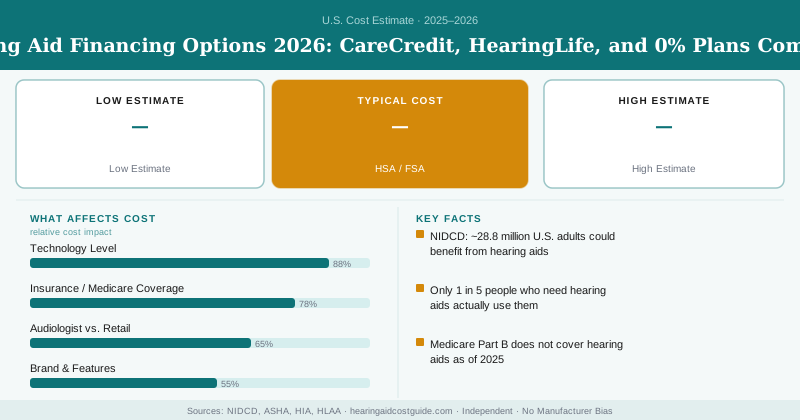
The NIDCD estimates 28.8 million U.S. adults could benefit from hearing aids — yet fewer than 1 in 3 who need them actually wear them. Cost is the single biggest reason people say no. A premium pair runs $4,000–$8,000. Even mid-range devices hit $2,000–$4,000. That’s a real financial obstacle, especially for adults on fixed retirement incomes.
The good news: you have more financing options than most people realize. The bad news: some of those options come with traps that can cost you hundreds of dollars extra if you’re not careful. Here’s what’s actually available in 2026.
Financing Options at a Glance
| Option | Typical APR | Term | Best For |
|---|---|---|---|
| CareCredit (promotional) | 0% deferred | 6–24 months | Full payoff guaranteed |
| CareCredit (standard) | 26.99% | Ongoing | Not recommended |
| HearingLife payment plan | 0%–14.9% | 12–48 months | HearingLife customers |
| Phonak EasyPay | 0% | 12–24 months | Phonak device buyers |
| Oticon financing | 0%–9.9% | 12–36 months | Oticon device buyers |
| Starkey financing | 0% | 12–18 months | Starkey buyers |
| Credit union personal loan | 7%–13% | 24–60 months | Predictable monthly payments |
| HSA / FSA | 0% (pre-tax) | N/A | Anyone with employer benefits |
CareCredit: The Most Widely Accepted Option
CareCredit is a healthcare-specific credit card accepted at audiology practices, HearingLife clinics, Costco Hearing Centers, and thousands of private practices nationwide. You apply in minutes — most decisions are instant.
How the promotional period works: Choose a 6-, 12-, 18-, or 24-month deferred interest plan. Pay zero interest if you pay the entire balance by the last day of the promotional period. Miss that deadline by even one day, and you owe the full deferred interest on the original purchase amount at 26.99% APR — retroactively, from day one.
That means a $4,000 pair of hearing aids with an 18-month plan could hit you with $1,440 in retroactive interest in month 19 if you haven’t paid it off. That’s not a scare tactic — it’s exactly how deferred-interest financing works, and it catches people off guard constantly.
When CareCredit makes sense: Only when you’re confident you’ll pay the full balance before the promotional period ends. Set up auto-payments for more than the minimum. Divide the total by the number of months and pay that exact amount every month.
The minimum monthly payment on a $4,000 CareCredit balance is typically $75–$100 — which looks manageable. But paying the minimum almost guarantees you won’t clear the balance before the promotional period ends. To pay off $4,000 in 18 months, you need to pay $222/month. Always calculate the required payoff amount before you commit.
HearingLife Financing Plans
HearingLife, one of the largest hearing aid retail chains in the U.S. with over 600 locations, offers in-house and third-party financing options directly at the point of sale. Their current plans run from 12 to 48 months and include both 0% promotional options and installment loans in the 9.9%–14.9% APR range.
The advantage of HearingLife financing is convenience — you set it up while you’re already at the clinic. The disadvantage is that you’re locked into HearingLife’s device selection, which may not offer the full range of brands your audiologist might otherwise recommend.
Manufacturer Payment Plans
Several major manufacturers offer their own financing, often through third-party lenders tied to their authorized dealer networks:
Phonak: Partners with CareCredit and offers through-dealer financing. Some dealers promote 12- or 24-month 0% plans on select device lines. Terms vary by dealer and device tier.
Oticon: Offers 0%–9.9% APR installment plans through select practices. Their Oticon Real and Oticon More lines are commonly featured in financing promotions.
Starkey: U.S.-based manufacturer with active financing programs — typically 0% for 12–18 months on their Genesis AI and Evolv AI lines. Available through authorized Starkey providers.
Manufacturer financing is only available through authorized dealers. If you buy hearing aids through a third-party retailer or discount reseller, you usually can’t access manufacturer payment plans. Always confirm financing availability before you commit to a device brand.
Credit Union Hearing Aid Loans
This option doesn’t get nearly enough attention. Credit unions regularly offer personal loans at 7%–13% APR — far lower than what you’d pay in retroactive CareCredit interest. And unlike deferred-interest plans, there’s no hidden penalty for slow repayment. You know exactly what you’re paying every month.
A $4,000 loan at 10% APR over 36 months costs about $129/month and roughly $636 in total interest. That’s the full price of ownership — predictable, transparent, no surprises.
Many credit unions also have healthcare loan programs specifically designed for elective medical expenses including hearing aids. Navy Federal Credit Union, USAA, and most regional credit unions offer these. If you’re not a member of a credit union, federally chartered credit unions are now open to nearly anyone willing to join via a nonprofit membership.
HSA and FSA: The Most Overlooked Option
If you have a Health Savings Account (HSA) or Flexible Spending Account (FSA) through your employer or an ACA marketplace plan, use it for hearing aids first. Hearing aids, hearing aid batteries, and professional fitting fees are all IRS-qualified medical expenses.
Every dollar you spend from an HSA is pre-tax. For someone in the 24% federal bracket, paying $3,000 from an HSA costs the equivalent of $2,280 in gross earnings. That’s a 24% discount compared to using after-tax dollars — better than any promotional financing plan.
HSAs don’t expire; FSAs usually have a use-it-or-lose-it rule (though many allow a 2.5-month grace period or $640 rollover). If you have both options, fund the HSA to maximum before using an FSA.
According to AARP, only about 12% of adults over 65 with employer-sponsored health coverage actively use their HSA accounts for hearing-related expenses, despite hearing aids being among the most expensive recurring medical costs in retirement.
What to Ask Before Signing Anything
Before you commit to any financing plan, get clear answers to these four questions:
- What is the APR if I don’t pay off the balance before the promotional period ends?
- Is this deferred-interest or true 0%? (True 0% = no penalty for slower payoff. Deferred interest = retroactive penalty.)
- What is the exact monthly payment needed to pay off in full before the deadline?
- Can I use my HSA/FSA card to make payments on this financing account? (With CareCredit, the answer is yes — you can load HSA funds to pay down the balance.)
The right answer isn’t always 0% financing. It’s the option that leaves you with the lowest total cost and the fewest financial surprises.
Frequently Asked Questions
CareCredit's 18-month or 24-month deferred-interest plans offer 0% APR if paid in full before the promotional period ends, making them the most cost-effective choice if you can budget accordingly. For smaller balances under $2,000, a credit union personal loan at 8–12% APR is often cheaper than deferred-interest plans because there's no retroactive interest penalty if you can't pay in full on time.
Yes. Hearing aids, hearing aid batteries, and audiologist fitting fees are all IRS-qualified medical expenses, so you can pay with a Health Savings Account (HSA) or Flexible Spending Account (FSA) card directly. Using pre-tax HSA/FSA dollars saves you 22–32% depending on your tax bracket — effectively making a $3,000 hearing aid cost $2,040–$2,340 after tax savings.
Yes. CareCredit is accepted at thousands of audiology practices, HearingLife locations, Costco Hearing Centers, and manufacturer-affiliated providers. It's one of the most widely accepted healthcare financing cards for hearing aids. The key watch-out: if you don't pay the full balance before the promotional period ends, you owe all deferred interest at once — often 26.99% APR retroactively applied to the original purchase amount.