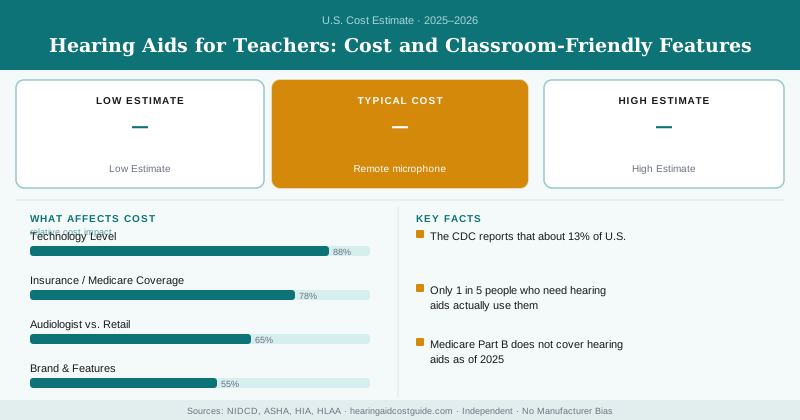
What does it cost a teacher to hear a kid in the back row over 28 chattering classmates? Around $1,500 to $5,500 per pair — and the right feature, not the highest price, makes the difference. A classroom is one of the hardest listening environments there is: reverberant, crowded, and full of soft young voices competing with HVAC hum.
Teaching with hearing loss is more common than people realize, and the fixes are better than ever. Here’s the real breakdown.
Teacher Hearing Aid Costs
| Option | Cost | Notes |
|---|---|---|
| OTC hearing aids | $799–$1,500/pair | Mild-moderate loss |
| Costco rechargeable | $1,499–$2,199/pair | Strong value, 3-yr care |
| Mid prescription RIC | $2,500–$4,000/pair | Good speech-in-noise programs |
| Premium prescription | $4,500–$5,500/pair | Best directional/noise tech |
| Remote microphone | $200–$350 | Game-changer for classrooms |
The Remote Mic Is the Secret Weapon
Forget chasing the priciest aids. For a teacher, the single highest-impact accessory is a remote microphone. You clip a small mic to a student or set it on a table, and their voice streams directly into your hearing aids, cutting through room noise. Cost: $200–$350, and it pairs with most mid- and premium-tier devices.
Classrooms routinely measure 60–70 dB of background noise even before anyone raises a hand. The CDC reports that about 13% of U.S. adults aged 12 and older have hearing loss in both ears — and educators sit squarely in that population while needing to hear better than almost anyone in any other job.
For teachers, a remote microphone ($200–$350) often helps more than upgrading to premium aids. Pair a $1,499–$2,500 mid-tier rechargeable pair with a remote mic and you’ll hear individual students clearly across a noisy room — for less than a top-tier device alone.
Features That Earn Their Keep in a Classroom
- Speech-in-noise programs. Mid-tier and up offer directional modes that focus on the voice in front of you and suppress side and rear noise.
- Rechargeable batteries. No fumbling with size 312 cells between periods. A rechargeable hearing aid gives you a full teaching day on one charge.
- Bluetooth for AV. Stream from your laptop, smartboard, or video lessons directly to your ears. See our Bluetooth hearing aid cost guide.
- Discreet styling. Many teachers prefer subtle receiver-in-canal units that disappear behind the ear.
Does Your School Insurance Help?
Some teacher health plans and union benefit packages include a hearing aid allowance — often $500 to $2,500 per ear every few years. Check your benefits booklet before paying out of pocket; FSA and HSA funds also cover hearing aids and remote mics. That can knock a serious chunk off the price.
The NIDCD estimates roughly 28.8 million U.S. adults could benefit from hearing aids, yet many delay for years. For a teacher, delay means missed questions, misheard names, and exhausting end-of-day fatigue from straining to listen. Treating it early pays off in energy alone.
Start With a Test
Before buying anything, get a baseline audiogram. Our hearing test cost guide walks through what to expect, and an audiologist visit is where you’ll demo remote mics in a simulated noisy setting — the closest thing to a classroom trial before you commit.
Don’t buy hearing aids based only on a quiet office demo. A classroom sounds nothing like a fitting room. Ask your audiologist for a trial period (most offer 30–45 days) and test the aids in real teaching conditions — a full school day, lunchroom duty, and a noisy assembly. If a remote mic isn’t included, request a loaner to try before you decide.
OTC or Professional?
If your loss is mild to moderate, an OTC hearing aid at $799–$1,500 can handle one-on-one and small-group teaching. But for a full classroom, the directional processing and remote-mic compatibility of prescription devices usually win. The good news is you don’t need the most expensive tier — you need the right accessory.
Compare every option in our complete hearing aid cost guide, and prioritize the remote mic. It’s the cheapest upgrade that does the most for a teacher.
Frequently Asked Questions
Hearing aids for teachers typically cost between $1,500 and $5,500 per pair, depending on the technology level and features. Basic models start around $1,500, while advanced models with classroom-specific features like speech-in-noise programs and remote microphone compatibility can reach $5,500 or more.
Coverage varies by plan; many private insurance policies cover 50-80% of hearing aid costs after meeting a deductible, while Medicare does not cover hearing aids at all. Teachers should check their employer-sponsored plans first, as some educational unions and school districts offer supplemental hearing aid benefits that can reduce out-of-pocket costs significantly.
Teachers should prioritize speech-in-noise programs and compatibility with remote microphone systems, which allow students or an instructor to wear a wireless mic that streams directly to the hearing aids. These features are more important than price alone, as they directly address the primary challenge of noisy classroom environments with multiple soft voices competing for attention.