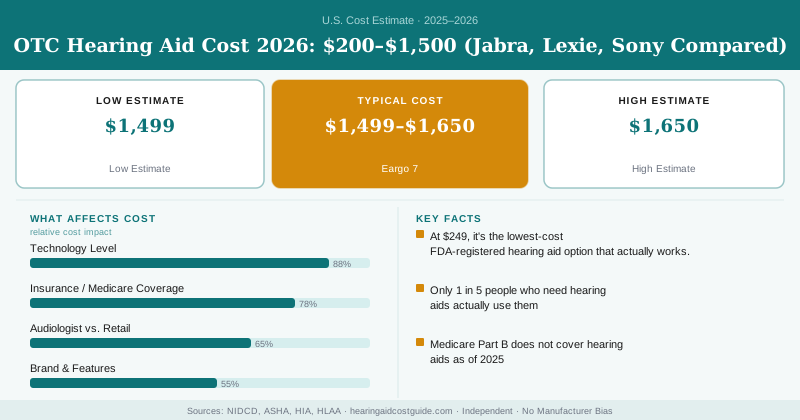
In October 2022, the FDA did something that hadn’t happened in the hearing healthcare industry in decades: it opened the market. The final rule allowing over-the-counter hearing aids for adults with mild to moderate hearing loss went into effect, and for the first time, you could walk into a CVS, Best Buy, or Walmart and buy a real, FDA-registered hearing aid without a prescription, without an audiologist, and without spending $3,000–$7,000.
That was a big deal. Here’s where things stand in 2026.
OTC Hearing Aid Price Comparison 2026
| Brand / Model | Price (per pair) | App-Based Fitting | Bluetooth Streaming | Trial Period |
|---|---|---|---|---|
| Jabra Enhance Pro 20 | $1,099–$1,199 | Yes | Yes | 100 days |
| Sony CRE-E10 | $999–$1,299 | Yes | No | 30 days |
| Sony CRE-20 | $799–$999 | Yes | No | 30 days |
| Lexie Lumen (powered by Bose) | $849–$999 | Yes | Yes | 45 days |
| Lexie B2 (powered by Bose) | $999 | Yes | Yes | 45 days |
| Apple AirPods Pro (2nd gen) | $249 | Via Health app | Yes | 15 days (Apple) |
| MDHearing VOLT Max | $399–$499 | Yes | No | 45 days |
| Audien Atom Pro | $299–$349 | No | No | 45 days |
| Eargo 7 | $1,499–$1,650 | Via audiologist phone support | No | 45 days |
The FDA Rule: What Changed in 2022 (And What Didn’t)
The FDA’s October 2022 rule created a new regulatory category: OTC hearing aids for adults with mild-to-moderate perceived hearing loss. Before this rule, every hearing aid required a prescription and a licensed dispenser.
What changed: Adults can now self-diagnose, self-select, and self-fit hearing aids without clinical involvement. Manufacturers can sell direct-to-consumer. Prices dropped 40–70% at the entry level.
What didn’t change: Prescription hearing aids still exist for people with severe or profound loss, complex profiles, or those who want full audiological care. The OTC category doesn’t replace prescription aids — it adds an option for a specific, large segment of the population. The FDA estimates 30 million American adults have hearing loss significant enough to benefit from hearing aids, but only about 20% of those who could benefit actually use them, largely due to cost.
Who Should — and Shouldn’t — Consider OTC
Good candidates for OTC:
- Adults with gradually worsening, symmetrical hearing loss in both ears
- People struggling mainly in noisy environments or with TV volume
- Anyone who finds themselves frequently asking people to repeat themselves
- Those with confirmed mild-to-moderate loss from a previous audiogram
Not good candidates:
- Children (OTC is adults 18+ only, legally)
- Single-sided deafness or significant asymmetry between ears
- Sudden or rapidly worsening hearing loss (needs medical evaluation first)
- Hearing loss accompanied by dizziness, pain, drainage, or a feeling of fullness
- Severe or profound hearing loss — OTC aids aren’t powerful enough
Sudden hearing loss — a significant drop in hearing over 72 hours or less — is a medical emergency. It requires an ENT evaluation within 24–48 hours for possible steroid treatment. Don’t buy an OTC hearing aid and wait it out. This is the one situation where immediate professional care can mean the difference between recovering your hearing and losing it permanently.
Jabra Enhance Pro 20: Best Overall OTC Pick
The Jabra Enhance Pro 20 consistently ranks at the top of independent OTC hearing aid reviews. At $1,099–$1,199 per pair, it’s not cheap by OTC standards — but it includes a 100-day trial (the longest in the industry), Bluetooth streaming, a polished app, and rechargeable batteries. Jabra partnered with GN Hearing, a professional-grade Danish hearing technology company, on the engineering. It shows.
The app-based fitting process uses a series of tone tests similar to a simplified audiogram. Setup takes about 15 minutes. Independent audiologists who have tested it note that the self-fitting accuracy is reasonable for mild-to-moderate high-frequency loss — which describes the majority of adult onset hearing decline.
Sony CRE-E10 and CRE-20: Best Invisible Design
Sony’s CRE models use a completely-in-canal design — you can barely see them. The CRE-E10 ($999–$1,299) sits deeper in the canal; the CRE-20 ($799–$999) sits at the canal opening. Neither streams Bluetooth audio, which is a meaningful limitation if you want to take phone calls through your hearing aids.
The self-fitting app is well-designed and Sony’s brand reputation gives many buyers comfort. The 30-day trial is shorter than competitors — if you want to know whether hearing aids will work for you, 30 days is tight.
Apple AirPods Pro: The Surprise Contender
Apple’s FDA-cleared hearing aid feature for AirPods Pro (2nd gen) is genuinely disruptive. At $249, it’s the lowest-cost FDA-registered hearing aid option that actually works. The in-app hearing test takes about five minutes and applies personalized amplification profiles.
The limitations are real: AirPods Pro weren’t designed as hearing aids first. They have a one-size-fits-most ear tip system that won’t seal properly in every ear canal. They’re also highly visible and obviously earbuds, which some users don’t mind and others find stigmatizing. Battery life when used continuously as hearing aids is shorter than purpose-built devices.
For someone with very mild loss who already owns AirPods Pro 2nd gen, enabling the hearing aid feature costs nothing and is worth trying. Buying them specifically for this purpose is a reasonable $249 experiment with Apple’s standard 15-day return window.
All FDA-registered OTC hearing aids are HSA/FSA eligible. This matters because paying with pre-tax dollars saves you 22–32% depending on your tax bracket. A $999 pair of Sony CRE-20s paid with HSA funds costs you the equivalent of $679–$779 in gross income. Check your HSA/FSA card — many work directly at Best Buy, Costco, and the brands’ own websites.
When to See an Audiologist Instead
OTC hearing aids make sense for the right person. But they’re not for everyone. See an audiologist if:
- You’ve never had an audiogram and aren’t sure of your loss level
- You’ve tried an OTC aid and it didn’t help
- Your hearing loss is noticeably worse in one ear than the other
- You’re having trouble understanding speech even in quiet rooms
- You’re over 75 and haven’t been professionally evaluated recently
An audiological evaluation typically costs $200–$350 without insurance, and the information it gives you is worth more than the cost. It tells you exactly what kind of loss you have, at which frequencies, and in which ear — the three data points that determine whether an OTC aid can actually help you.
Frequently Asked Questions
OTC hearing aids are FDA-intended for adults 18 and older with perceived mild-to-moderate hearing loss. They're self-fit — you program them yourself using a smartphone app, without seeing an audiologist. They're not appropriate for children, severe or profound hearing loss, single-sided deafness, sudden hearing loss, or hearing loss with associated symptoms like dizziness, ear pain, or drainage, which require professional evaluation.
For mild-to-moderate high-frequency loss — the most common adult pattern — top OTC models like Jabra Enhance Pro 20 and Sony CRE-E10 perform comparably to entry-level prescription devices in independent studies. They're not equivalent to premium prescription aids for severe loss, complex audiometric profiles, or situations requiring real-ear measurement verification. But for the right candidate, they're genuinely effective at a fraction of the cost.
Apple released a Hearing Aid feature for AirPods Pro (2nd generation) in fall 2024, FDA-cleared as an OTC hearing aid. It works through a self-administered hearing test in the Health app and applies personalized amplification. It's a legitimate option for mild loss, though independent audiologists note that AirPods Pro fit less securely than purpose-built hearing aids and may not provide consistent acoustics for all ear canal shapes.