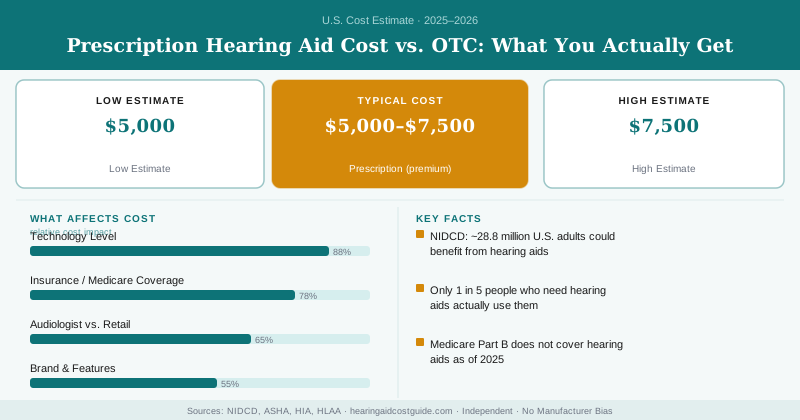
Looking for overall hearing aid pricing? Our complete hearing aid cost guide covers all styles from $200 OTC to $7,000 prescription pairs, insurance coverage, and how to pay less. This page specifically compares prescription vs. OTC value.
“Why would anyone pay $5,000 for hearing aids when you can get them on Amazon for $300?” It’s a fair question, and the answer depends entirely on your hearing loss profile — and what you’re actually paying for beyond the hardware.
Let’s break it down honestly.
Prescription vs. OTC: Price at a Glance
| Type | Typical Cost (Per Pair) | Fitting Included | Max Loss Treated |
|---|---|---|---|
| OTC (budget) | $199–$599 | Self-fit via app | Mild |
| OTC (premium) | $600–$1,599 | Self-fit + remote support | Mild-to-moderate |
| Prescription (entry) | $2,000–$3,500 | Audiologist-fit | Moderate |
| Prescription (mid) | $3,500–$5,000 | Audiologist-fit | Moderate-to-severe |
| Prescription (premium) | $5,000–$7,500 | Audiologist-fit, full follow-up | Severe-to-profound |
What You’re Actually Paying for With a Prescription Device
Professional Diagnosis and Fitting
A licensed audiologist performs a comprehensive audiological evaluation (typically $200–$350 if billed separately), selects devices matched to your audiogram, and performs real-ear measurement (REM) to verify the hearing aid is delivering the right amplification at each frequency.
REM takes about 20 minutes and significantly improves outcomes — but roughly 30% of dispensers skip it even with prescription devices, according to a 2023 Hearing Review survey. Ask specifically whether your fitting includes REM. If the answer is vague, push harder.
More Powerful Hardware Options
Prescription-only devices cover severe and profound hearing loss that OTC devices legally can’t address. They also include specialized programs: tinnitus masking, directional microphone arrays, made-for-iPhone/Android compatibility, telecoil functionality for loop systems in theaters and airports. The Hearing Loss Association of America (HLAA) estimates that 15% of American adults have some degree of hearing loss — and a meaningful chunk of those people need more than what an OTC device can offer.
Bundled Follow-Up Care
Most bundled prescriptions include 2–3 years of follow-up appointments for reprogramming, cleaning, and adjustments. That’s worth $300–$800 in unbundled fees you won’t have to pay out of pocket.
When comparing quotes, ask whether pricing is bundled (device + all services) or unbundled. Unbundled pricing looks cheaper upfront — say, $2,000 device plus $150 per visit — but costs more if you need frequent adjustments in year one. Bundled pricing is better for most new hearing aid users.
Where Prescription Hearing Aids Cost Less
Costco Hearing Aid Centers: $1,500–$3,000 per pair for the same hardware sold elsewhere for $4,000–$5,500. You work with a hearing instrument specialist (HIS), not a doctoral audiologist, but service quality is generally solid.
Veterans Administration: Eligible veterans receive prescription hearing aids at no cost. The VA dispensed over 900,000 hearing aids to veterans in fiscal year 2023 alone — it’s one of the most underutilized benefits in American healthcare.
HLAA and state programs: The Hearing Loss Association of America maintains a list of state assistance programs, several of which provide prescription devices at reduced or no cost to qualifying low-income adults.
When OTC Is Genuinely Fine
The FDA cleared OTC devices for adults 18+ who perceive mild-to-moderate hearing loss. Audiologists recommend OTC when:
- Your audiogram shows bilateral (both-ear) mild-to-moderate high-frequency loss
- You don’t have dizziness, sudden or asymmetric loss, or drainage
- You’re comfortable using a smartphone self-fitting app
- You’ve had a hearing test within the past 2–3 years to confirm the loss type
Self-diagnosing your degree of hearing loss is unreliable. A 2022 JAMA study found that adults significantly underestimate their hearing loss when self-reporting. If you’ve been avoiding social situations or asking people to repeat themselves constantly, get an audiogram before assuming OTC will cut it.
When You Absolutely Need Prescription
- Severe or profound hearing loss (>70 dB HL)
- Asymmetrical hearing loss — a significant difference between ears
- Single-sided deafness
- Sudden hearing loss onset
- Conductive hearing loss requiring medical evaluation
- Children under 18 (always prescription, always audiologist)
- Tinnitus requiring specialized programming
The Honest Cost Math
If you’re a healthy 65-year-old with symmetrical moderate high-frequency loss:
- OTC Jabra Enhance 500: $1,499. Good outcomes for many people.
- Costco Jabra Enhance Pro: $1,799 + professional fitting. Better outcome certainty.
- Private audiologist premium device: $5,500. Best-in-class technology and care.
Unless you specifically need the features and professional support of a premium prescription device, the Costco middle path delivers 80–90% of the outcome at 30–40% of the cost. That’s a reasonable trade-off for most people.
Frequently Asked Questions
Prescription hearing aids typically cost $2,000–$7,000 per pair, while OTC hearing aids range from $200–$1,500 per pair. The price difference reflects professional fitting, advanced customization, and typically better technology for moderate-to-severe hearing loss, whereas OTC options are designed for mild hearing loss and self-fitting.
Most traditional health insurance plans, including Medicare, do not cover hearing aids; however, some Medicare Advantage plans and Medicaid programs in certain states offer partial or full coverage. You should contact your insurance provider directly to confirm coverage, as out-of-pocket costs typically range from $1,500–$7,000 per pair for prescription aids depending on your plan and device choice.
After an audiologist confirms hearing loss through testing, the fitting appointment typically takes 1–2 hours and can often be scheduled within 1–3 weeks. You'll receive your hearing aids at the fitting visit, with follow-up adjustments scheduled over the next few weeks to optimize performance for your specific hearing loss profile.